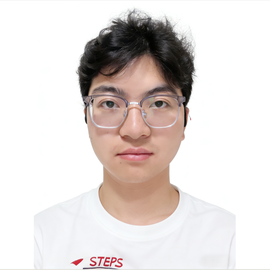
Biography
Xiaoxiang Han is a Ph.D. candidate at the SMART Lab, School of Communication and Information Engineering, Shanghai University, Shanghai, China, supervised by Prof. Qi Zhang. He is dedicated to closely integrating artificial intelligence with healthcare. His main research interests include pattern recognition, medical image/video analysis, weakly/semi/self-supervised learning, and trustworthy AI. Beyond his research, he also maintains an interest in clinical medicine, biomedicine and cognitive neuroscience.
Interests
- Medical Image/Video Analysis
- Weakly/Semi/Self-Supervised Learning
- Pattern Recognition
- Trustworthy AI
Education
-
PhD in Information and Communication Engineering
Shanghai University
-
MEng in Electronic Information, 2024
University of Shanghai for Science and Technology
Papers
(2026).
Adapting without Access: Black-Box Bayesian Adaptation for Trustworthy Cross-Center Medical Image Segmentation.
In MICCAI 2026.
(2026).
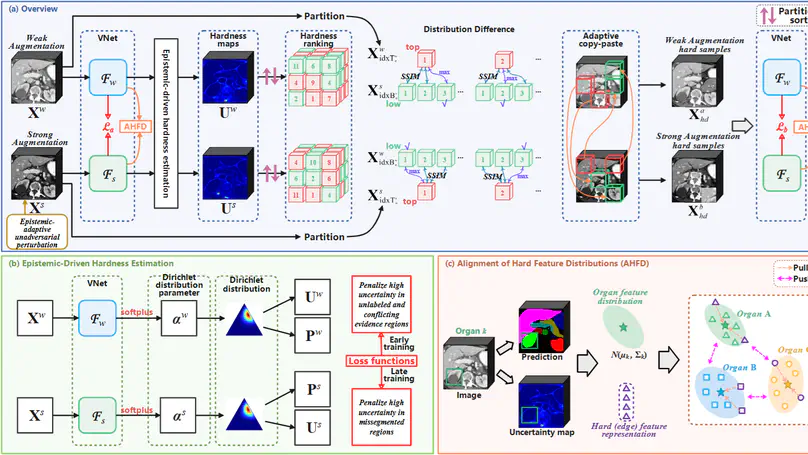
Scribble-Supervised Multi-Organ Segmentation via Epistemic-Driven Hardness-Adaptive Focusing.
In IEEE Transactions on Medical Imaging.
(2025).
MambaEviScrib: Mamba and Evidence-Guided Consistency Enhance CNN Robustness for Scribble-Based Weakly Supervised Ultrasound Image Segmentation.
In Information Fusion.
(2024).
A Semi-Supervised Approach with Error Reflection for Echocardiography Segmentation.
In BIBM 2024.
(2024).
A multi-domain feature alignment and hierarchical cross feature enhancement network for under-sampled magnetic image reconstruction.
In Applied Intelligence.
(2024).
Reconstruction of Cardiac Cine MRI Using Motion-Guided Deformable Alignment and Multi-Resolution Fusion.
In International Journal of Imaging Systems and Technology.
(2024).
Intelligent detection of left ventricular hypertrophy from pediatric echocardiography videos.
In International Journal of Imaging Systems and Technology.
(2024).
Atrial Septal Defect Detection in Children Based on Ultrasound Video Using Multiple Instances Learning.
In Journal of Imaging Informatics in Medicine.
(2023).
EDMAE: An Efficient Decoupled Masked Autoencoder for Standard View Identification in Pediatric Echocardiography.
In Biomedical Signal Processing and Control.
(2023).
LOANet: A Lightweight Network Using Object Attention for Extracting Buildings and Roads from UAV Aerial Remote Sensing Images.
In PeerJ Computer Science.
Popular Topics
Atrial Septal Defect
Cine MRI
Domain Adaptation
Echocardiography Segmentation
Echocardiography Sgmentation
Epistemic uncertainty
Handwritten Mathematical Expression
Handwritten Recognition
Latex
Left Ventricular Hypertrophy
Lightweight Network
Masked Autoencoder
Medical Image Sgmentation
MRI Reconstruction
Multiple Instances Learning
Pediatric Echocardiography
Remote Sensing
Scribble-Supervised Learning
Transformer
Ultrasound Video
Contact
- hanxx@shu.edu.cn
- No. 99 Shangda Road, Baoshan District, Shanghai, 200444